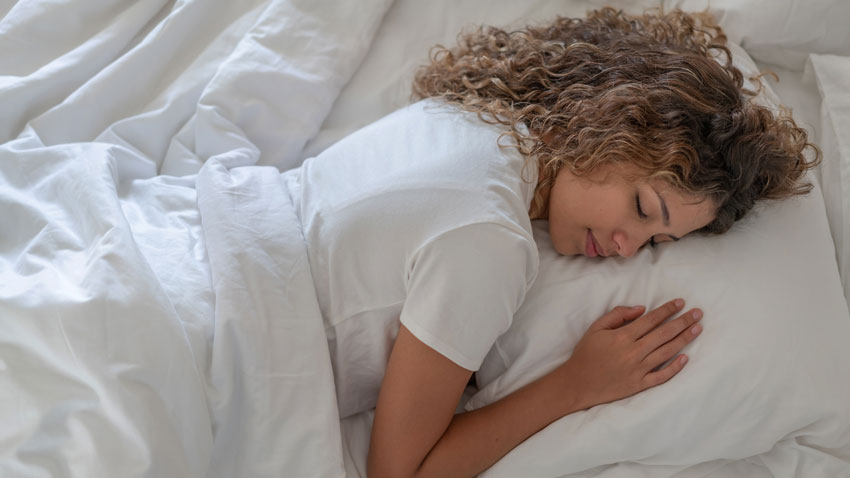
When you do wake up in the middle of the night, it’s important to get yourself into a calm and relaxing headspace. Overnight, your brain’s prefrontal cortex, which helps govern logic, executive function, and rational thought, is recharging, meaning it’s easier for your emotions to run wild. Getting into relaxation mode is critical, so finding the right relaxation techniques could be the key to finding sleepiness again. Your path to relaxation might involve reading a book, practicing gentle yoga poses, or sipping a warm cup of tea.
Jade Wu, Ph.D., a behavioral sleep medicine specialist and Sleep Advisor to Mattress Firm, mentions that the point of relaxation techniques is “to get out of the mind and into the body.” Often racing thoughts or frustration about a lack of sleep can create anxiety and adrenaline that prevent us from feeling the calm we need to drift back to sleep. It’s ok to test a few relaxation techniques to find which one you enjoy best. Stick to that one so that it becomes habitual for overnight awakenings.
Deep-Breathing Techniques to Fall Back Asleep
If practicing gets you into a more relaxed and calm frame of mind, it could help you fall back asleep after waking. Breathwork isn’t just for yogis. Studies show that the right breathing can lower heart rate and bring on calmness—even Navy Seals practice breathwork for intense situations. Their version, box breathing, involves visualizing a box made up of four, four-second lines. To complete the box, you breathe in for four counts, hold for four counts, breathe out for four counts, then hold your empty lungs for four before commencing a new breath box.
Some studies have shown that taking six breaths per minute can be ideal for lowering heart rate and promoting a relaxed state. Start by finding a comfortable position. With eyes closed, inhale through the nose for a count of four. Hold for a second before gently exhaling through the mouth for a count of four. Some sleepers also find it beneficial to repeat a calming word or phrase during this breathing exercise.
Progressive Muscle Relaxation for Better Sleep
We’re often tense throughout the day as we deal with stressors and anxieties of life. This tenseness can easily interrupt our sleep if we’re not mindful to relax. Eliminating stress points can help as a physical reminder to your brain to unwind. Progressive muscle relaxation is a technique that involves focusing on one area of the body at a time and then flexing the muscles and releasing.
“Systematically tensing and releasing different muscle groups throughout the body from head to toe can help us experience a deep presence of relaxation,” Troxel explains. “This method is really good for those who need to do something more physical if they want to relax.” She also mentions this could be a great addition to a sleep hygiene routine done before bed.
To practice this, find a comfortable position in bed. Slowly focus on one area of the body at a time, starting at the head or the foot. Tense the area and hold before slowly releasing into a relaxed position.
Wu adds that progressive muscle relaxation can also help because it gives the sleeper something to focus on rather than getting caught up in the frustration of not being able to fall back to sleep. She recommends mentally checking in with each body part and making sure all is well, starting with your littlest toe.
Mindfulness and Meditation for Improved Sleep Quality
Mindfulness and meditation can improve sleep quality since they promote relaxation. Both focus on the mind in the present moment with no other distractions. To practice these, find a comfortable position in bed or in your home. With eyes closed, focus on your breath and the feeling of air moving in and out of your body. If your mind starts to wander, bring the focus back to each breath. The purpose is to always be in the present moment without any worrying thoughts.
You might also want to try out apps like Calm or Headspace that are designed to help with guided meditation or calming audio stories that could help lull you back to sleep.
Visualization Techniques for a Return to Slumbe
Imagine you’re in your favorite place in the world, enjoying a peaceful moment. Visualization techniques like this can help you fall back to sleep by promoting calming thoughts. This can be something like going to a happy place, or it can also be little items like walking downstairs one step at a time, says Wu.
One of the most common visualization techniques is counting sheep, but your ideal visualization might involve laying on a beach watching waves come in or standing on a mountaintop. To practice visualization when you can’t fall back to sleep, get comfortable in bed and take some deep, relaxing breaths. Visualize your location and focus on details of colors, sounds, and the feel of your surroundings. You can also combine these visualization exercises with deep breathing if that feels best for creating a calm mind.
Troxel also recommends using this as a way to initially fall asleep, with the hope of it helping you stay asleep.
Yoga and Stretching for Better Sleep
Gentle yoga or stretching could also be great for helping you get back to sleep. “It's all about being in the moment with your body, feeling the sensations in your body, and following your breath,” Wu says. “That can just really get your body to be in a very happy place and relax.” To practice yoga or stretching, be sure you’re in a comfortable place and wearing comfortable clothing. Focus on slow, gentle movements and deep breaths.
You can also add gentle bedtime yoga into your nightly sleep routine. “This would help signal your body and mind that it’s time for relaxation,” adds Wu.
Relaxing Music to Promote Rest
Music can have a strong impact on our moods and thoughts. If you’re trying to fall back asleep, it can offer a calming element to focus on. “It really just kind of takes a chatter in your mind away and like… puts you in a better mood, and that helps you fall asleep,” Wu explains.
Choose music you find calming and relaxing to listen to, either in or out of bed, if you’re trying to fall back asleep. It’s also important to be mindful of disrupting a sleep partner while considering if your music device exposes you to blue light. Troxel recommends using a music device that isn’t your cell phone since that could cause further arousal from the blue light and the temptation to check texts, email, or social media rather than making you more relaxed and ready for bed again.
Writing Down the Worry and Leaving It Behind
Rather than let anxiety churn in your brain, it can be helpful to offload it into a notebook.
One of Wu’s favorite iterations of this also overlaps with the tip of visualization. “One of my favorite methods is leaves on the stream, where you walk yourself through a forest, sit down at a stream and imagine putting your thoughts on leaves and putting the leaves on the stream and watching the leaf float away in its own time,” she says.
You can also leave a notepad beside your bed and write down any concerns or anxiety-producing thoughts as they arise. Both Wu and Troxel say some people do best with a scheduled worry time during the day, far before bedtime. This time is dedicated exclusively to worrying about anything bothering you.
“Write down whatever's on your mind and close the notebook,” Wu says. “And then know you’ve downloaded the thoughts from your brain to paper, and you don't need to hold that in your mind anymore,” Wu says.
If you wake up in the middle of the night with worrying thoughts, remind yourself that you have dedicated “worry time” set aside tomorrow to deal with those thoughts that are disruptive to relaxation.